Beyond the Airshow: How the Red Arrows Forge Combat-Ready Aviators
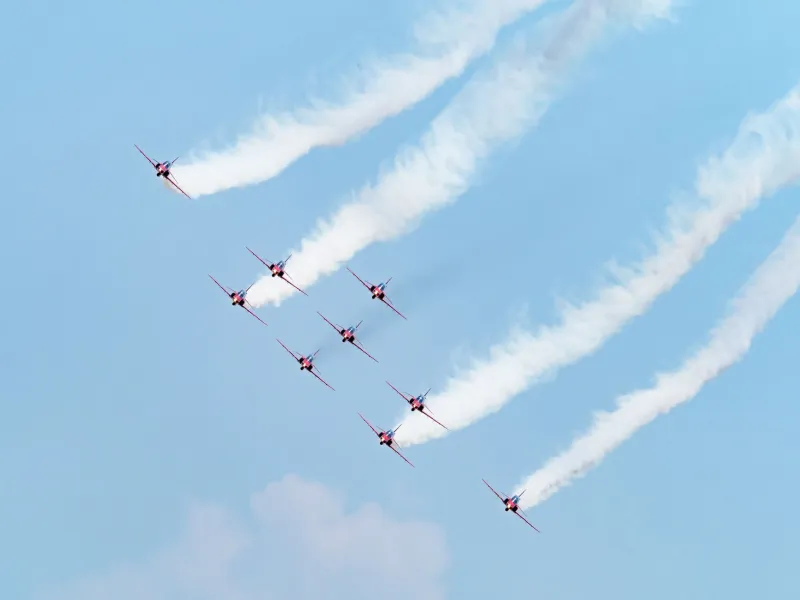
For most Britons, the sight of nine scarlet Hawks trailing plumes of red, white, and blue smoke across a summer sky is synonymous with national pride and celebration. The Royal Air Force Aerobatic Team — universally known as the Red Arrows — has been the public face of British aviation excellence since 1965. Yet to regard the team solely as a ceremonial showpiece is to fundamentally misunderstand its enduring value to the RAF's operational capability. Behind the spectacle lies one of the most demanding flying programmes in British military aviation, one that quietly produces pilots of exceptional skill, composure, and situational awareness.
The Selection Process: Earning the Red Suit
Entry into the Red Arrows is neither straightforward nor guaranteed to even the most accomplished RAF fast-jet pilot. Candidates must hold a current operational tour on a frontline fast-jet aircraft, typically accumulating a minimum of 1,500 flying hours before their application is considered. The selection process itself is exhaustive, involving a formal assessment at RAF Scampton — historically the team's home base — where candidates fly with current team members and are evaluated not only on their airmanship but on their temperament, communication skills, and ability to function under sustained pressure.
The team typically selects between one and three new pilots each season, known within the organisation as 'Reds.' These individuals must serve a minimum of three years, with many electing to complete the full permitted tenure. The deliberate limit on tenure ensures a constant rotation of talent back into the broader RAF, spreading the benefits of Red Arrows training across frontline squadrons.
Formation Flying as a Tactical Discipline
To the uninitiated observer, formation flying may appear to be an exercise in aesthetics — nine aircraft moving in choreographed unison for the pleasure of a crowd. In practice, it demands a quality of concentration and spatial awareness that has direct and measurable parallels in combat aviation.
Flying in close formation at speeds exceeding 400 miles per hour, with wingtip separations measured in feet rather than metres, requires a pilot to process an extraordinary volume of sensory information simultaneously. Throttle inputs, stick movements, horizon references, and the positioning of adjacent aircraft must all be managed with a precision that tolerates virtually no error. This environment accelerates the development of what experienced aviators refer to as 'stick and rudder' mastery — the instinctive, almost subconscious ability to manage an aircraft's attitude and energy state without conscious deliberation.
Squadron Leader pilots who have completed Red Arrows tours and subsequently returned to operational Typhoon or Tornado squadrons have noted that their capacity to manage complex cockpit environments under stress improved markedly during their time with the team. The cognitive load of a nine-ship formation manoeuvre, they argue, provides an unusually effective preparation for the multi-threat, high-workload scenarios encountered in operational theatres.
Situational Awareness: The Invisible Dividend
Perhaps the most transferable skill developed within the Red Arrows is situational awareness — the continuous, dynamic understanding of one's own position, the positions of other aircraft, and the evolving nature of the environment. In combat aviation, degraded situational awareness is a primary contributing factor in both mid-air incidents and tactical failures. The Red Arrows, by demanding an almost superhuman degree of positional awareness during every sortie, effectively inoculates pilots against the kind of attentional narrowing that can prove catastrophic in hostile airspace.
Formation leaders within the team bear an additional burden. Responsible for calling manoeuvres, monitoring the position of eight other aircraft, and simultaneously communicating with air traffic control and the display commentator, the team leader operates under a command pressure that mirrors, in certain respects, the responsibilities of a formation leader conducting a strike package over contested territory. Decision-making speed, clarity of communication, and the ability to maintain composure when circumstances deviate from the briefed plan are all competencies honed through repeated exposure during the display season.
The Winter Work-Up: Where the Real Training Happens
The public sees the Red Arrows during the summer display season, but the genuine developmental work occurs during the winter work-up period, typically running from October through to the spring public debut. During these months, the team flies an intensive programme of sorties that progressively build from pairs and four-ships through to the full nine-aircraft formation. Every manoeuvre is filmed, debriefed, and critiqued in meticulous detail.
The debrief culture within the Red Arrows is frequently cited by former team members as one of its most professionally formative elements. Errors are identified without blame but without omission, and the team operates on the principle that honest, constructive critique is the primary mechanism of improvement. This culture of rigorous self-assessment translates directly into the debrief practices of frontline squadrons, where the ability to conduct and receive objective performance reviews is a hallmark of effective operational units.
From Display Flying to the Front Line
The transition from the Red Arrows back to a frontline squadron is, by all accounts, a demanding adjustment — the skills developed are highly transferable, but the operational context differs substantially. Former team members returning to Typhoon squadrons, for instance, must reintegrate the weapons systems, sensor management, and tactical doctrine that necessarily take a back seat during a display tour. Nevertheless, the consensus among those who have made this transition is that the Red Arrows experience leaves them better pilots in the broadest sense: more precise, more composed, and more capable of managing high-workload environments.
The RAF's decision to maintain the Red Arrows as an active component of its structure — rather than a purely civilian or contracted display operation — reflects an institutional recognition of this value. The team serves the nation as a diplomatic and public relations asset, certainly, but it also serves the Service as a training and development engine, one whose outputs are distributed across the force with each successive generation of pilots.
A Legacy Written in the Sky
The Red Arrows will continue to draw crowds to airshows from Fairford to Farnborough, and the spectacle they provide remains one of Britain's most beloved public traditions. But for those within the RAF who understand the full scope of what the team represents, the significance of those nine red Hawks runs considerably deeper than the applause that follows each display. They represent a commitment to excellence in airmanship that, season after season, quietly produces some of the finest aviators in the Royal Air Force.