Stitched, Sealed and Certified: The Quiet Discipline of RAF Aircrew Life Support
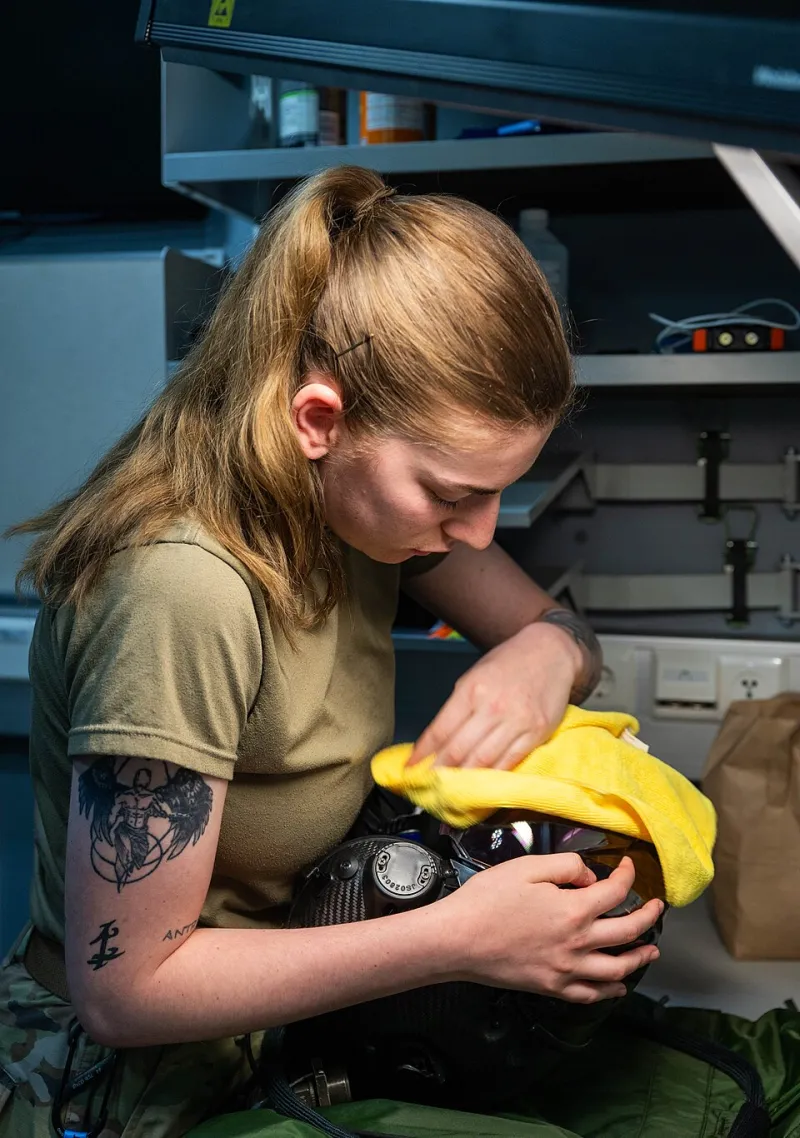
Photo: U.S. Air Force photo by Airman 1st Class Sierra Casteel, Public domain, via Wikimedia Commons
A pilot climbing into a cockpit looks, to the casual observer, like a person putting on a uniform. In reality, the equipment being worn has passed through a chain of custody, inspection and certification that would satisfy the most exacting auditor. The helmet, the mask, the immersion suit, the life preserver and the survival pack are not personal possessions. They are accountable items with serial numbers, life limits and documented histories, and the people who manage them are as central to flying safety as any engineer on the line.
The section behind the crew room
Life support sections sit within the engineering organisation of a squadron or station, often in modest accommodation a short walk from the HAS or the pan. Their work is structured around the flying programme: equipment is issued before flight, recovered afterwards, inspected, cleaned, recharged, repaired or sent away for deeper servicing, then returned to the store ready for the next task.
The rhythm is unglamorous and relentless. A single fast-jet squadron may hold dozens of complete aircrew equipment assemblies, each with a servicing schedule that runs to the day. Helicopter units add immersion suits and survival packs configured for over-water operations. Transport squadrons carry equipment for large, mixed crews flying long missions. Every type has its own quirks, and the specialists are expected to know them all.
Helmets, masks and the oxygen chain
Flying helmets are precision items. Liners, visors, communications fitments, night vision goggle mounts and, in some cases, display hardware all have to function together while remaining comfortable enough to wear for hours. Small defects matter: a loose connector can mean lost intercom at the worst possible moment, and a scratched visor can compromise vision in low light.
Oxygen equipment receives particular scrutiny. Modern types such as the Typhoon use on-board oxygen generating systems, which changes the maintenance burden but does not remove it; the mask, the hose and the connections remain life-critical. Each is inspected, leak-tested where required and recorded. The documentation matters as much as the hardware, because the airworthiness system depends on being able to demonstrate that a given item was in a given condition at a given time.
Clothing that has to work in the sea
For crews operating over water, the immersion suit is the most consequential item in the wardrobe. It has to keep a person alive long enough to be recovered, which means sealing at the wrists, ankles and neck, buoyancy provision, and a thermal layer that still permits movement in a cockpit.
Suits are inspected for delamination, seam integrity and seal condition, then pressure-tested in some cases to confirm they will not fail on contact with cold water. Life preservers are checked for inflation mechanism function, cylinder condition and date limits. Survival packs are inventoried item by item: signalling aids, first aid supplies, thermal protection, water and the small items that become disproportionately important when a crew is waiting to be found.
The parachute store
Parachutes occupy a category of their own. Packing is a controlled activity carried out by trained personnel under supervision, with each pack signed off and traceable. Life limits are tracked carefully, and any exposure to moisture or unusual conditions triggers a mandatory inspection rather than a judgement call.
Ejection seat components, cartridges and associated egress equipment sit at the boundary between life support and the wider engineering discipline, and are handled by specialists who work to the same culture of documented precision. The system is designed on the assumption that a single unrecorded deviation is one too many.
From routine to emergency
The measure of a life support organisation is not how well it performs on a normal Tuesday but how it performs when the routine is broken. A defect discovered at the aircraft, a suit damaged during an exercise, an unserviceable item identified hours before a long-planned sortie: each requires an immediate decision about whether the crew can fly, what can be substituted and what has to be escalated.
That decision-making is underpinned by training. Aircrew themselves rehearse the use of survival equipment at establishments such as the Defence Survival, Evasion, Resistance and Extraction Training Wing at RAF St Mawgan in Cornwall, where sea survival drills and equipment familiarisation are part of the syllabus. The specialists who maintain the kit often support that training directly, because familiarity with the equipment in a pool is what makes it usable in open water.
Discipline without applause
Life support work rarely features in coverage of the RAF, and its practitioners seem content with that. Yet the logic of the discipline is worth stating plainly: modern military aviation is only survivable because a great many people are prepared to treat small details as though they mattered absolutely.
A helmet that fits, a mask that seals, a suit that keeps the water out and a pack that contains what it should: none of these will ever appear in a photograph of an aircraft departing on operations. They are, nonetheless, the reason the crew has a reasonable prospect of coming home if the sortie goes wrong.