The Invisible Fleet: Inside the RAF Logistics Machine That Keeps Air Power Alive Across the Globe

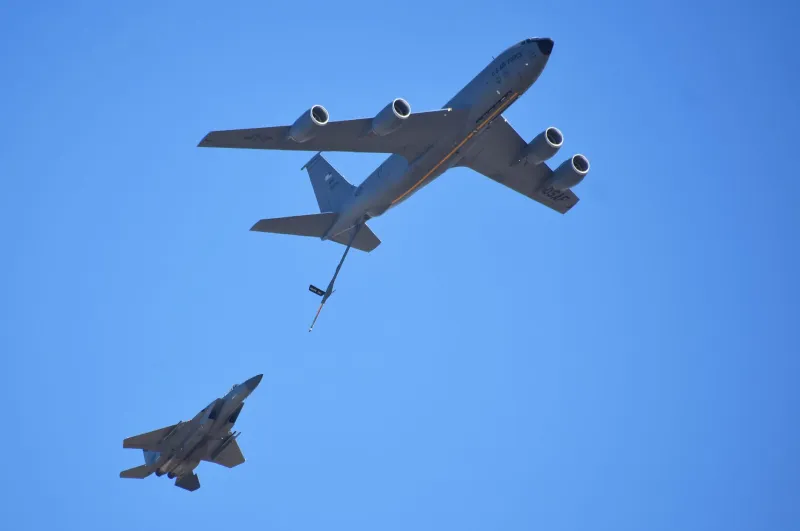
Photo: US Government, Public domain, via Wikimedia Commons
The photograph that appears on the front pages shows the Typhoon on the runway, the pilot's helmet catching the desert light. What it does not show is the logistics officer in Brize Norton who spent forty-eight hours sourcing a specialist hydraulic seal from a supplier in the West Midlands, arranging its transit to a forward operating base in the Middle East, and ensuring it cleared customs in a country where English is nobody's first language — all so that aircraft could fly its scheduled sortie.
This is the RAF's invisible fleet: the network of people, systems, and processes that make operational air power possible. It receives a fraction of the attention lavished on the aircraft it sustains. It is, nonetheless, arguably the most sophisticated logistical enterprise in British defence.
The Scale of the Challenge
The RAF currently operates across a remarkable breadth of geographic environments. From the frigid South Atlantic, where the Mount Pleasant Complex in the Falkland Islands sustains a permanent air defence and patrol commitment, to the heat and dust of RAF Akrotiri in Cyprus and the sustained rotational presence in the Middle East, the service maintains operational aircraft on multiple continents simultaneously.
Each of those aircraft — whether a Typhoon FGR4, a Voyager tanker, a Poseidon P-8 maritime patrol aircraft, or an Atlas A400M transport — represents an extraordinarily complex assembly of components, systems, and sub-systems, each with its own maintenance schedule, certification requirement, and supply chain dependency. The RAF's current fast jet and support fleet runs to well over two hundred airframes. Keeping them mission-ready is not a passive exercise; it is a continuous, demanding operational commitment in its own right.
The Architecture of RAF Logistics
At the institutional level, RAF logistics is organised through a framework that spans the Defence Equipment and Support organisation at Abbey Wood, the Air Command logistics function, and the individual station engineering and supply squadrons that operate at the sharp end of the supply chain.
The introduction of the Integrated Logistic Support model — borrowed and adapted from commercial aviation and defence procurement best practice — has reshaped how the RAF thinks about the relationship between aircraft procurement and the long-term support of those platforms. Under ILS principles, supportability is designed into a platform from the outset, rather than being bolted on as an afterthought once the aircraft enters service.
In practice, this means that when a Poseidon P-8 requires a component replacement at RAF Lossiemouth, the supply chain that delivers that component has been mapped, validated, and stress-tested as part of the platform's original support contract with Boeing. The same logic applies, with local variations, to every major type in the RAF inventory.
Technology at the Heart of the System
The RAF's logistics function has undergone a substantial technological transformation over the past two decades. The MERLIN system — the service's primary maintenance and engineering resource management platform — provides a digital backbone through which engineering officers can track asset availability, manage maintenance schedules, and identify supply chain bottlenecks before they become operational problems.
More recently, the wider Ministry of Defence has been investing in Defence Digital systems that seek to integrate logistics data across the single services, reducing duplication and improving the visibility of assets held across the entire defence estate. For RAF logistics officers, greater data integration means a clearer picture of what is available, where it is held, and how quickly it can be moved.
Predictive maintenance — using sensor data from aircraft systems to anticipate component failures before they occur — is an area of growing interest. If an engine health monitoring system on a Typhoon indicates that a particular bearing is approaching the end of its serviceable life, the ideal outcome is that the replacement part is already in the supply chain before the aircraft lands. Achieving that consistently, across a mixed fleet operating in diverse environments, remains one of the central challenges of modern RAF logistics.
The Human Dimension: Problem-Solving at the Limits
No system, however sophisticated, eliminates the need for human ingenuity when circumstances deviate from the expected. RAF logistics officers are quick to emphasise that the most demanding aspects of their work arise precisely when the textbook solutions do not apply.
At Mount Pleasant, the combination of geographic isolation, limited airlift availability, and the unforgiving South Atlantic environment means that the supply chain must be managed with particular rigour. Aircraft cannot simply divert to a nearby maintenance facility if a component fails; the nearest major support base is thousands of miles away. The engineering and supply teams at MPC maintain carefully calibrated holdings of critical spares, but the judgements about what to hold, in what quantities, and for how long, require a level of operational experience and analytical discipline that goes well beyond straightforward inventory management.
Similar pressures apply in the Middle East, where the RAF's rotational presence demands that logistics pipelines function reliably across multiple national jurisdictions, each with its own customs regime, import restrictions, and bureaucratic requirements. A component held up at a Gulf airport because of a documentation error does not simply cause inconvenience; it can ground an aircraft and affect an operational commitment.
"The job is fundamentally about anticipation," explained one senior logistics officer with experience across multiple theatres. "You're always trying to be three problems ahead. The ones that catch you out are the ones you didn't imagine."
Strategic Airlift and the Logistics Enabler
The RAF's strategic airlift fleet — principally the Atlas A400M and the ageing but still capable C-17 Globemaster III — plays a central role in the logistics enterprise, not just as a means of moving troops and equipment, but as the arterial system through which spare parts, technical publications, specialist tools, and engineer personnel flow to remote operating locations.
The A400M's combination of strategic range and tactical landing capability makes it particularly valuable in this context. Its ability to operate from relatively unprepared strips means that it can reach locations that would be inaccessible to the C-17, extending the reach of the logistics chain into environments where previous generations of RAF transport aircraft could not operate.
The management of airlift capacity — balancing operational tasking, logistics requirements, and training commitments — is itself a complex planning exercise, coordinated through the Air Mobility Operations Centre at RAF Air Command.
Why Logistics Is the Measure of Air Power
There is a well-worn aphorism in military circles, attributed in various forms to various commanders, that amateurs study tactics while professionals study logistics. The RAF's experience across three decades of sustained operational commitments has demonstrated the truth of that observation with considerable force.
An air force with outstanding aircraft and exceptional pilots cannot project power if its supply chains are fragile, its maintenance pipelines are congested, or its logistics officers lack the skills and authority to solve problems at speed. The RAF's ability to sustain combat-effective operations from the North Atlantic to the Indian Ocean rests, ultimately, on the unglamorous and largely unacknowledged work of the people who keep the parts moving.
The next time a Typhoon lifts off from Akrotiri or a Poseidon banks over the South Atlantic, it is worth remembering the invisible fleet that made it possible.