Lift and Reach: How the RAF's Transport Fleet Quietly Underpins Britain's Place in the World
There is a particular kind of power that never makes the front pages. It does not generate vapour trails over airshows, nor does it feature prominently in defence white papers. Yet without it, Britain's stated ambition to be a globally deployable military force would remain precisely that — an ambition. Strategic airlift is the unglamorous machinery of geopolitical credibility, and the Royal Air Force operates it with a quiet professionalism that deserves considerably more scrutiny than it typically receives.
The Aircraft That Move the Machine
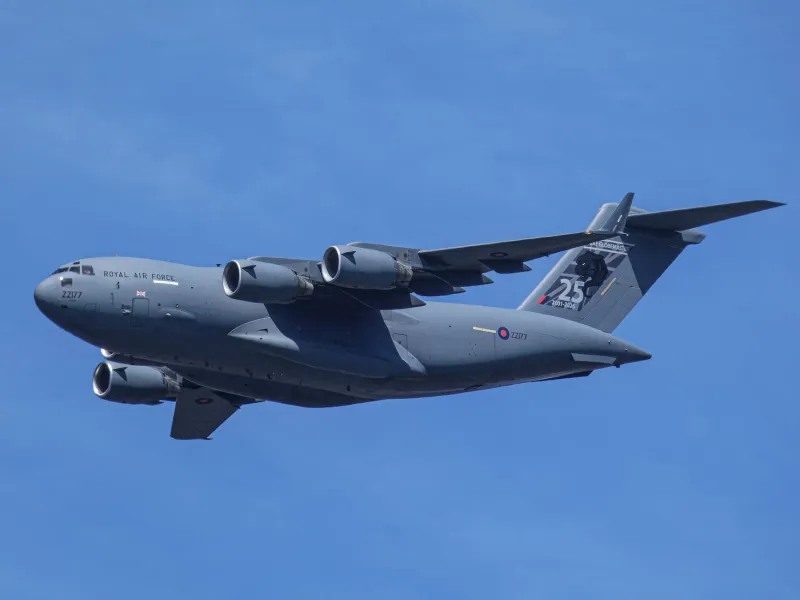
The RAF's transport fleet is built around two primary platforms, each serving a distinct but complementary role. The Boeing C-17A Globemaster III, operated by 99 Squadron at RAF Brize Norton, represents the upper tier of strategic reach. Capable of carrying over 77 tonnes of cargo, deploying outsized equipment including armoured vehicles and helicopters, and operating from austere airstrips that would defeat a conventional freighter, the C-17 is an instrument of genuine strategic effect. Britain operates eight of these aircraft — a modest number by American standards, but sufficient to sustain a meaningful autonomous deployment capability.
The Airbus A400M Atlas, operated by 70 Squadron and LXX Squadron also from Brize Norton, occupies a different but equally vital niche. More versatile than its predecessor the C-130 Hercules, the A400M bridges the gap between tactical and strategic airlift. It can deliver troops and equipment to forward operating locations, conduct aerial refuelling in a tanker configuration, and sustain operations in environments where the C-17's sheer scale becomes a liability. The RAF currently operates twenty-two A400Ms, making it one of the larger European operators of the type.
The VC10, once the backbone of the RAF's air-to-air refuelling force, has now been retired, with its tanking responsibilities consolidated onto the A330 Voyager. That transition, though broadly successful, removed a degree of redundancy from the fleet — a point that has not gone unnoticed by those who study the service's capacity under sustained operational pressure.
Projecting Force Without Permanence
Britain's defence posture since the end of the Cold War has been shaped by a deliberate policy choice: rather than maintaining extensive networks of permanent overseas bases, the UK has invested in the ability to deploy forces rapidly to wherever they are needed. This approach, sometimes described as an 'expeditionary' model, places an enormous premium on strategic airlift.
The logic is straightforward. Permanent bases are expensive, politically sensitive, and increasingly vulnerable to precision strike in any future peer conflict. The ability to surge forces from the home base — to project a credible military presence at short notice across multiple theatres — offers flexibility that fixed installations cannot. It is a model that suits Britain's geography, its alliance commitments, and its defence budget realities.
Operational history validates the concept. During the evacuation of Kabul in August 2021, RAF C-17s and A400Ms flew repeated sorties into Hamid Karzai International Airport under conditions of considerable uncertainty, extracting over fifteen thousand people in a matter of days. The operation was imperfect, constrained by the political circumstances that produced it, but it demonstrated the practical value of maintaining a capable, responsive airlift force. Without those aircraft and the crews trained to operate them under pressure, Britain's contribution to one of the most complex non-combatant evacuation operations in recent memory would have been negligible.
The Tanker Dimension
Strategic airlift cannot be considered in isolation from air-to-air refuelling. The Voyager fleet — nine aircraft operating in a dual passenger and tanker configuration — extends the reach of the RAF's combat aircraft and enables long-range deployments that would otherwise require intermediate staging posts. The deployment of Typhoons to the Falkland Islands, or the extension of patrol patterns over the North Atlantic, depends directly on Voyager support.
Yet the dual-role nature of the Voyager creates its own tensions. An aircraft committed to moving personnel or equipment cannot simultaneously be available for tanking operations. During periods of heightened operational tempo, prioritising between these roles becomes a genuine planning challenge, and the relatively small size of the fleet means that attrition or unplanned maintenance can have disproportionate effects on overall capability.
Investment Decisions and Future Pressures
The strategic airlift fleet faces several converging pressures over the coming decade. The C-17 production line closed in 2015, meaning that any aircraft lost to accident or attrition cannot be replaced with new-build examples. The second-hand market for C-17s exists, but it is limited and competitive. The RAF's eight aircraft represent a finite and irreplaceable asset, and the service must balance operational use against the long-term sustainment of the fleet.
The A400M programme, meanwhile, continues to mature. Early deliveries were affected by well-documented technical difficulties, but the aircraft has grown steadily more capable as software updates and modifications have been incorporated. The full operational capability of the type — including its self-protection systems and enhanced airdrop performance — remains a work in progress, though the trajectory is broadly positive.
Looking further ahead, the question of whether Britain should invest in additional strategic airlift capacity, or accept the current fleet size as the ceiling of its ambition, is one that defence planners cannot defer indefinitely. Renewed great-power competition, the return of high-intensity warfighting as a credible scenario, and the expanding demands placed on UK forces by NATO commitments all point towards a requirement for greater lift capacity, not less. Whether the Treasury will fund that ambition is, as ever, the more difficult question.
The Human Factor
Behind the airframes and the procurement figures are the aircrew and engineers of No. 1 Air Mobility Wing — the formation that encompasses the RAF's transport and tanker squadrons at Brize Norton. These are professionals who operate with a lower public profile than their fast jet counterparts, but whose contribution to British defence is no less significant. Long-haul missions, irregular schedules, and the sustained operational tempo of recent years have placed real demands on personnel and their families.
Retaining experienced transport aircrew in a competitive commercial aviation market is a persistent challenge, one that mirrors pressures felt across the RAF as a whole. The service has introduced various measures to improve retention, but the structural advantages that airlines offer — predictable rosters, competitive pay, and the absence of deployment risk — are difficult to match within the constraints of the public sector.
Conclusion
Strategic airlift will never attract the same attention as a new fighter jet or an aircraft carrier sailing into harbour. It lacks the visual drama that defence coverage tends to favour. But for any nation that aspires to act independently on the world stage — to respond to crises, to honour alliance commitments, to evacuate its citizens from danger — the ability to move forces and materiel swiftly across intercontinental distances is not optional. It is foundational. Britain's transport fleet is the quiet guarantee behind the louder promises of its foreign and defence policy, and it deserves to be understood as such.