Still Sharp: The Ongoing Effort to Keep the Typhoon Relevant in an Era of Escalating Threats
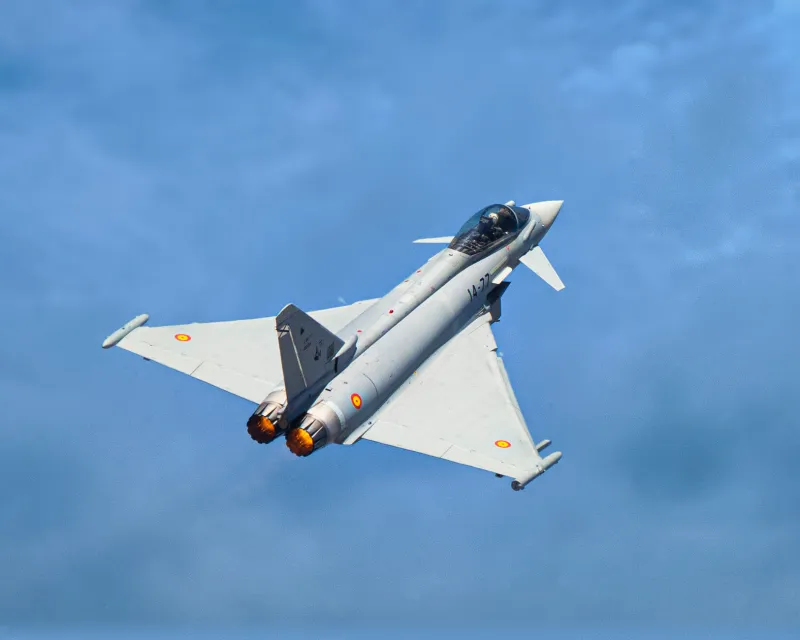
When the Eurofighter Typhoon first entered service with the Royal Air Force in 2003, it was conceived primarily as an air superiority platform — an aircraft designed to dominate the skies over Central Europe in a conflict that, by the time it arrived, had already ceased to be the defining scenario of British defence planning. Two decades later, the Typhoon has evolved well beyond its original specification. It has dropped bombs over Libya, conducted air policing missions from the Falklands to the Baltic, and accumulated a combat record that few European fighters can match. Now, with its replacement still years from operational service, the RAF is investing heavily in ensuring that the Typhoon can remain a credible combat aircraft well into the 2030s.
The Architecture of Improvement
The Typhoon's upgrade trajectory is best understood not as a single programme but as a series of overlapping tranches, each adding capability in specific areas. The aircraft's modular avionics architecture, sometimes described as one of its most underappreciated design features, allows new systems to be integrated without requiring wholesale redesign of existing infrastructure. This has proven invaluable as the threat environment has shifted in ways that the aircraft's original designers could not have anticipated.
The most significant near-term upgrade is the integration of the ECRS Mk2 radar, developed by Leonardo UK. This active electronically scanned array (AESA) system represents a generational improvement over the Captor-M mechanically scanned radar currently fitted to most RAF Typhoons. AESA radars offer faster scanning rates, greater resistance to jamming, simultaneous air and ground search modes, and the ability to perform electronic attack functions — the last of these being a capability that blurs the boundary between radar and electronic warfare system in ways that will be operationally significant. The ECRS Mk2 is expected to enter service on RAF Typhoons in the latter part of this decade, and its arrival will materially improve the aircraft's ability to operate in contested electromagnetic environments.
Weapons and the Integration Challenge
Capability is only as good as the weapons a platform can deliver, and the Typhoon's weapons suite has expanded considerably in recent years. The integration of the Meteor beyond-visual-range air-to-air missile has been particularly consequential. Meteor's ramjet propulsion gives it a so-called 'no-escape zone' — the volume of airspace from which a targeted aircraft cannot manoeuvre to safety — that is substantially larger than that of any comparable missile. Against modern adversaries equipped with capable electronic countermeasures and high-performance fighter aircraft, this matters enormously.
On the ground attack side, the Typhoon now carries the Brimstone precision strike missile and the Storm Shadow cruise missile, giving it a reach and precision that were absent from early production aircraft. The integration of these weapons has not been without difficulty — the Typhoon was designed as an air superiority fighter, and adapting it for the full spectrum of strike operations has required sustained engineering effort — but the result is an aircraft that can credibly prosecute both air and surface targets in the same mission.
Future weapons integration work is likely to focus on hypersonic threats and the growing requirement to engage targets at greater stand-off distances. How much of this work can be accommodated within the Typhoon's existing airframe and avionics architecture is a question that will shape procurement decisions over the coming years.
Software as a Strategic Asset
Modern combat aircraft are, in many respects, software platforms that happen to fly. The Typhoon is no exception. The aircraft's operational flight programme — the software that governs its systems, sensors, and weapons — is updated regularly, with each new release adding functionality, correcting anomalies, and adapting the aircraft to new operational requirements. This process, managed through the Typhoon Integrated Avionics programme, is less visible than hardware upgrades but arguably more important to day-to-day operational capability.
The RAF has invested significantly in its ability to update and adapt the Typhoon's software rapidly, recognising that in a conflict scenario the ability to field software patches addressing newly identified adversary tactics could prove as decisive as any hardware modification. This approach — treating software agility as a capability in its own right — reflects lessons absorbed from observing how other air forces, particularly the United States Air Force, have approached the sustainment of complex combat aircraft.
The Replacement Question
The shadow of the Global Combat Air Programme (GCAP) — the trilateral effort between the United Kingdom, Japan, and Italy to develop a sixth-generation combat aircraft — falls across every discussion of the Typhoon's future. GCAP is intended to deliver an aircraft to replace the Typhoon in the mid-2030s, though the precise timeline remains subject to the inherent uncertainties of a complex international development programme.
The implication is clear: the Typhoon will remain in RAF service for at least another decade, and quite possibly longer if GCAP encounters delays of the kind that have affected virtually every major combat aircraft programme in recent history. This makes the current upgrade investment not merely prudent but essential. An RAF operating Typhoons in 2035 without the ECRS Mk2 radar and the full Meteor-equipped weapons suite would be flying an aircraft of diminishing relevance against adversaries who have not stood still.
There is also a subtler point about industrial capability. The engineering work required to upgrade and sustain the Typhoon keeps Britain's combat aircraft industrial base active and skilled. The teams at BAE Systems, Leonardo UK, and MBDA working on Typhoon enhancements today are the same teams whose expertise will be required to develop and deliver GCAP. Allowing that expertise to atrophy by deferring investment in the Typhoon would impose costs on the future programme that are difficult to quantify but easy to imagine.
Operational Implications
For the squadrons flying Typhoons from Lossiemouth and Coningsby, the upgrade programme translates into a cycle of aircraft availability, training on new systems, and the gradual absorption of enhanced capability into standard operating procedures. This process is rarely smooth. New sensors require new tactics; new weapons require new training pipelines; new software requires familiarisation that takes time away from other activities.
The RAF's Typhoon Force has managed these transitions with considerable competence, but the demands of the upgrade programme, layered on top of sustained operational commitments including Quick Reaction Alert duties, overseas deployments, and exercise participation, place real pressure on both personnel and aircraft availability.
Conclusion
The Typhoon's story is not one of a platform coasting towards obsolescence. It is, rather, the story of a mature airframe being continuously sharpened to meet threats that evolve faster than any procurement cycle can comfortably accommodate. The investments being made today — in radar, weapons, and software — are calculated bets that the aircraft will remain a credible deterrent through the decade ahead. Given the strategic environment Britain faces, those bets are not merely reasonable. They are necessary.