The Quiet Multiplier: How a Handful of Voyagers Underwrites Every RAF Mission
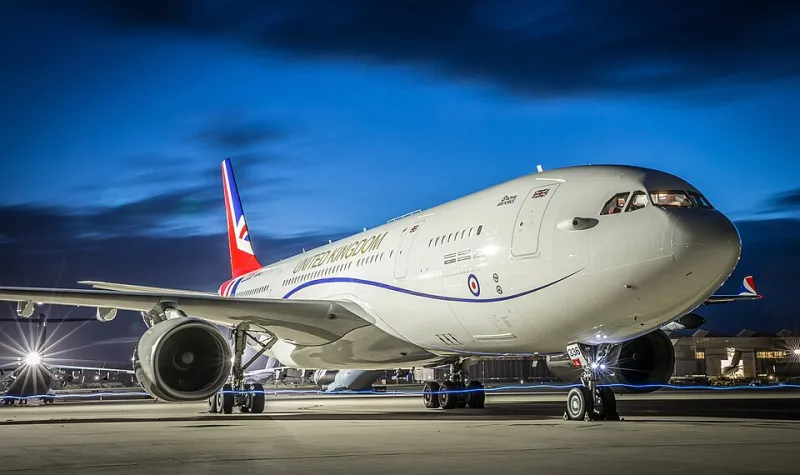
Photo: Sgt 'Matty' Matthews RAF, OGL v1.0, via Wikimedia Commons
Ask a Typhoon pilot what limits a long-range mission and the answer is rarely the fighter. It is fuel, and the aircraft that carries it. Britain's air-to-air refuelling capability rests on a single type — the Airbus Voyager — and on a fleet small enough to be counted on two hands. In 2026 that arithmetic sits at the heart of every serious discussion about how far, how long and how often the Royal Air Force can operate.
A force multiplier measured in hours
Voyager is routinely described as a force multiplier, a phrase worn smooth by repetition. For planners the multiplier is concrete. A tanker orbit over the Norwegian Sea buys a four-ship of Typhoons additional time on a defensive patrol. A refuelling track off the east coast keeps a Rivet Joint collecting signals for hours beyond its unrefuelled endurance. A Voyager supporting a carrier-enabled Lightning detachment turns a modest sortie into a credible strike package. None of that is free. Every one of those hours is drawn from a finite pool shared by every command that needs fuel in the air.
The complication is that Voyager is not only a tanker. The same airframes move personnel and freight, carry casualties on aeromedical taskings and provide strategic lift when the transport fleet is stretched. One aircraft cannot fly a refuelling track over the North Sea and a trooping run into the eastern Mediterranean in the same week. Every tasking decision is therefore a trade, and someone at a desk has to make it.
Fourteen aircraft, nine of them core
The RAF's Voyager force is provided under the Future Strategic Tanker Aircraft arrangement with AirTanker, a 27-year private finance contract signed in 2008 and running into the mid-2030s. Fourteen aircraft form the fleet. Nine are funded as core aircraft, available year-round; the remaining five can be brought into service as surge capacity at additional cost. The arrangement has delivered a modern, reliable aircraft — and it has also fixed the size of the force in a way that a conventional purchase would not.
That number explains much of the pressure. Voyager supports Typhoon, the F-35B force, Rivet Joint, A400M and a long list of coalition receivers. It underwrites the air bridge for deployments east of Suez and provides the tanker support that makes sustained intelligence, surveillance and reconnaissance viable. Set against the breadth of that demand, a core fleet of nine is a thin margin — and margins are precisely what capability reviews are made of.
The desk that decides who flies
Much of the tanker story happens far from any cockpit. A scheduling cell at RAF Brize Norton balances operational tasking, training requirements and transport commitments against airframe availability and crew duty limits. Requests arrive from front-line squadrons, from permanent joint headquarters and from allies. Priorities are set, moved and occasionally overturned at a few hours' notice.
The training bill is easy to overlook. Air-to-air refuelling is a perishable skill on both sides of the hose, and Voyager crews must maintain currency while their aircraft are also in demand for operational tasking. A tanker sortie flown to keep a captain current is not a wasted flight; it is the reason a receiver squadron can plug in with confidence three months later.
Engineering against a commercial clock
On the ground, engineers maintain a fleet whose availability is measured in contracted hours. The aircraft's hose-and-drogue pods — underwing units on the KC2 and a centreline hose on the KC3 — are precision equipment that must be serviced, tested and certified. Depth maintenance, modifications and unscheduled defects all compete for slots in a schedule shaped as much by contract terms as by engineering logic.
The result is a maintenance culture that thinks in availability rather than sorties. An aircraft that is fit to fly but not fit to refuel is of limited operational value, and the chain that keeps pods serviceable is as significant as the airframe itself.
The 2026 pressure test
The demands of 2026 are not modest. NATO's northern flank, the enduring commitment to enhanced Forward Presence in Estonia, maritime patrol over the North Atlantic and the wider Middle East all generate appetite for tanker hours. The Lightning force, now well established, relies on Voyager for reach that its short unrefuelled legs cannot supply alone.
The strategic question, asked more openly each year, is whether Britain has bought enough tanker to fight the way it says it will. Combat mass is usually discussed in terms of squadrons and weapons; it is equally a function of how many receivers can be kept on station. A force that can generate sorties but cannot sustain them gains very little.
How much is enough?
There is no clean answer. Options under discussion include adjusting the core-and-surge balance, investing in additional pods or aircraft, and looking ahead to a successor capability — potentially through multinational cooperation, and potentially alongside uncrewed tankers that would extend reach without extending crew numbers.
What is certain is the tax. Every decision to buy, deploy or sustain a combat aircraft carries a tanker corollary that rarely appears in the headline figure. Britain's air power rides on a handful of Voyagers, and the people who schedule, fly and fix them understand that better than anyone.