The Go/No-Go Desk: Inside the RAF Weather Branch That Shapes Every Sortie
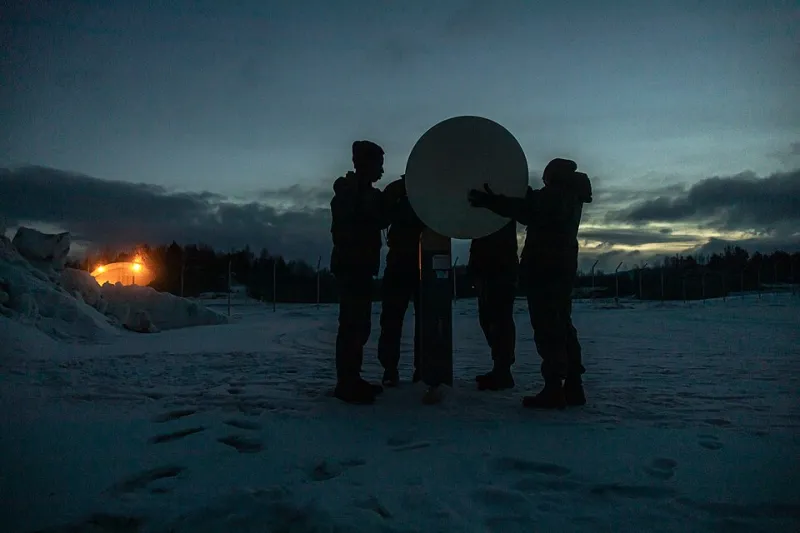
Photo: U.S. Marine Corps photo by Chief Warrant Officer Bryan Nygaard, Public domain, via Wikimedia Commons
At four in the morning a station is quiet in the way only an airbase can be: runway lights, a distant generator, the smell of aviation fuel. In a small office near the operations room an officer is studying a satellite loop and a spread of ensemble forecasts, deciding whether the day's flying programme will survive contact with the weather.
A branch built on judgement
RAF meteorologists — commissioned officers and senior non-commissioned officers of the meteorological branch — are the people who convert model output into a decision. Their training is technical and unforgiving, and it is built on a close relationship with the Met Office, whose forecasting college and scientific infrastructure underpin much of the branch's professional education.
What distinguishes a military forecaster from a civilian one is not the science but the framework. A public forecast answers the question of what the weather will do. A military forecast answers a narrower and harder question: whether a specific aircraft, crew and tasking can tolerate what the weather might do. That requires knowing the difference between a tailwind and a crosswind limit, between a cloud base and a recovery minimum, between a risk worth accepting and one that is not.
The morning brief
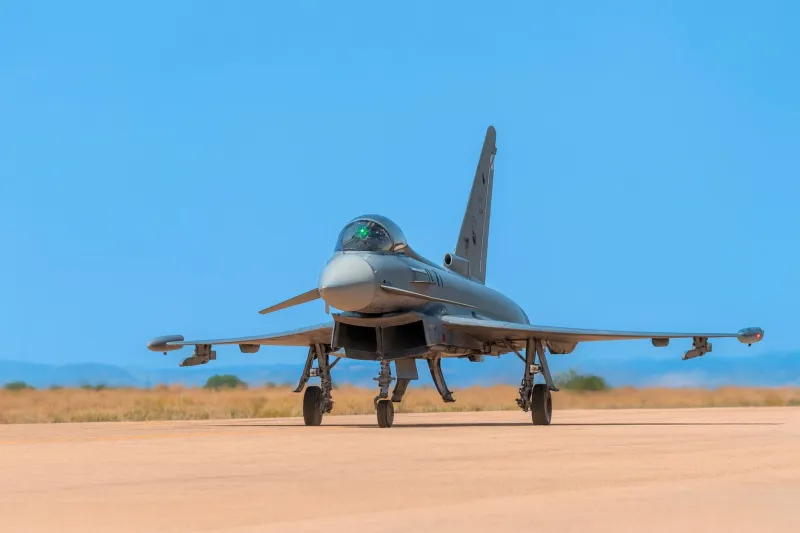
A briefing to a Typhoon squadron at Coningsby is not a lecture on synoptic charts. It is a compressed, precise assessment: crosswind components for the duty runway, cloud base and visibility for recovery, icing risk in the climb-out, the chance of embedded thunderstorms through the operating window, and the timing of any frontal passage that might close the airfield later.
A helicopter crew heading into the Scottish mountains needs something different. Mountain wave activity, low cloud on the approach, wind at altitude, the risk of whiteout on a snow-covered slope and the availability of a diversion all matter more than an average surface wind. A remotely piloted aircraft crew working a long intelligence, surveillance and reconnaissance tasking will ask about cloud structure and top heights, because the sensor's effectiveness depends on where the aircraft sits relative to the weather rather than how pleasant the weather is.
The same forecaster may brief all three in a single day, switching between the languages of different communities.
Probabilities, not prophecies
Modern forecasting is probabilistic by design. Ensemble models run the same atmosphere many times with slightly different starting conditions, producing a spread of plausible futures rather than a single answer. The forecaster's job is to interpret that spread, account for known model biases and local effects — the sea breeze that never shows in the model, the fog that forms in the valley behind the station — and present a confidence level the commander can use.
This is where the human being remains indispensable. A thirty per cent chance of a thunderstorm is either an acceptable risk or a reason to reschedule, depending on the mission, the aircraft and the consequences of an abort. Communicating that judgement clearly, and briefly, is a skill learned on the desk rather than in the classroom.
Weather for machines as well as crews
Recent years have widened the branch's remit. Space weather — solar activity that can disturb satellite communications and precision navigation — is now part of the operating picture for missions that depend on satellite links. Sea state and swell forecasts matter to maritime cooperation. Dust, sandstorms and extreme heat shape the risk calculus for deployed operations in the Middle East, while ice and snow dominate winter planning on NATO's northern flank.
As the RAF operates more uncrewed systems and more network-dependent aircraft, the weather question increasingly applies to data links and sensors as much as to airframes.
The Mobile Met Unit
The branch's most visible work overseas is done by its deployable element, which sends forecasters alongside operational headquarters and expeditionary air wings. A forecaster arriving at a deployed base in Estonia or the Middle East brings two things the local station cannot: familiarity with the mission's sensitivity to weather, and the habit of briefing the commander who will make the decision.
Deployed forecasting is often done with less data than a home station enjoys, and with more at stake. The ability to build a useful picture from limited observations, a satellite feed and experience of the region is what separates a competent forecaster from a good one.
Quiet influence
Meteorology rarely appears in recruitment material and almost never in headlines. Yet the forecast is one of the first mission planning decisions of every day, and the branch's advice shapes flying programmes, tasking decisions and sometimes the outcome of an operation. Air power is often described in terms of aircraft, weapons and crews. Weather is the variable that quietly determines whether any of them can be used.