Breaking the Ceiling: How Female Fast-Jet Pilots Are Reshaping the RAF's Operational Identity

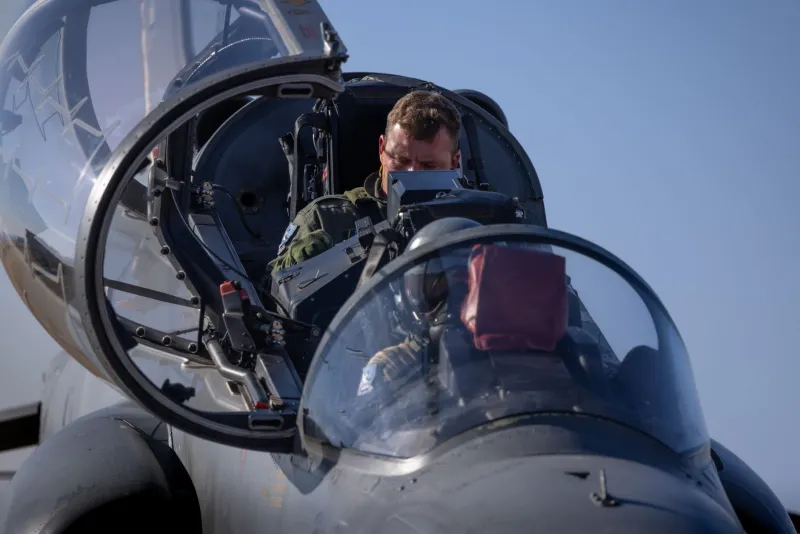
Photo by Photo by Lee Peterson on Unsplash on Unsplash
The numbers remain modest. Women constitute a relatively small proportion of the RAF's fast-jet pilot cohort, and the service is candid about the distance that still separates aspiration from achievement when it comes to gender representation in its most demanding flying roles. But the significance of their presence is not reducible to statistics alone. The female combat pilots now flying Typhoon FGR4 and F-35B Lightning II on operational sorties represent something more than a demographic milestone; they represent a fundamental reappraisal of what the RAF believes it is, and what kind of talent it needs to survive in an increasingly competitive strategic environment.
A Policy Change That Took a Generation to Embed
When the Ministry of Defence announced in 1994 that women would be permitted to fly in combat roles, the decision was received in some quarters with scepticism. The argument was made — as it has been made in every military institution that has confronted this question — that the presence of women in front-line roles would compromise unit cohesion, operational effectiveness, or both.
Three decades of evidence have not been kind to that argument. Female pilots have served on fast-jet squadrons, flown operational missions in contested airspace, and met the same exacting standards applied to every other member of their crews. The question of whether women could perform these roles was answered definitively some years ago. The more interesting question now is what it has taken to create an environment in which they can thrive — and what work remains to be done.
The Pipeline: From Recruitment to Front-Line
The journey from aspiring aviator to front-line fast-jet pilot is long, demanding, and attritive regardless of gender. Initial Officer Training at RAF Cranwell is followed by Elementary Flying Training, then the Military Flying Training System pathway through Preflight, Basic Fast Jet, and Advanced Fast Jet phases before a student pilot reaches an Operational Conversion Unit and, ultimately, a front-line squadron.
At each stage, the standards are absolute. The RAF does not apply different benchmarks to different groups of candidates, and nor would the service's operational requirements permit it to do so. A Typhoon does not care about the demographic profile of its pilot; neither does the threat environment in which that pilot operates.
What the RAF has recognised, however, is that the pipeline through which candidates flow is not gender-neutral in its cultural dimensions, even where it is formally identical in its requirements. Research conducted for the RAF's own diversity and inclusion reviews has consistently identified that the initial decision to apply for a flying career — the moment at which a young person looks at the RAF and asks whether this is a world in which someone like them might belong — is shaped by representation, visibility, and the stories that circulate within communities about who the RAF is for.
Recruiting From a Wider Pool
The RAF's recruitment challenges are well documented. The service competes for technically gifted young people against universities, the technology sector, and a commercial aviation industry that offers its own considerable attractions. In this environment, the ability to draw from the full breadth of British talent — regardless of gender, background, or ethnicity — is not merely a matter of social policy; it is a strategic necessity.
"If you're only attracting candidates from fifty percent of the population, you're starting with a significant self-imposed disadvantage," one senior RAF officer observed, speaking in the context of a broader discussion about the service's talent pipeline. "The best fast-jet pilots are wherever they are. Our job is to find them and give them the opportunity to succeed."
Data from the RAF's own recruitment statistics indicate that applications from women to pilot roles have increased measurably over the past decade, though the absolute numbers remain well below those from male applicants. The service has invested in targeted outreach programmes — including the RAF's Air Cadets organisation, which now counts hundreds of thousands of young people among its membership — designed to broaden the demographic profile of those who consider a flying career.
Inside the Squadron: Culture in Transition
The cultural environment of a fast-jet squadron is one of the most intensely performance-focused in any professional context. Reputation is built and assessed through demonstrated capability; the debrief culture that characterises RAF flying training extends into front-line operations, where every sortie is subject to rigorous collective review.
For female pilots joining front-line squadrons, this culture presents both challenges and opportunities. The challenge is that any environment shaped over decades by a predominantly male population carries embedded assumptions and informal norms that are not always visible to those who have always operated within them. The opportunity is that a culture genuinely organised around merit and operational performance provides, in principle, precisely the conditions under which individual capability should be recognised on its own terms.
The experiences of female fast-jet pilots vary. Some describe squadron environments that are straightforwardly professional, where their gender is neither an obstacle nor a particular subject of comment. Others speak of more subtle dynamics — the weight of being perceived as a representative of a group rather than simply an individual, the particular scrutiny that attaches to being among the first in any category, the occasional assumption that achievement requires explanation.
"You get used to being asked about it," said one Typhoon pilot, reflecting on her experience of joining a front-line squadron. "What you want is for the question to eventually stop being interesting. The mission is interesting. The flying is interesting. Whether I'm a woman doing it shouldn't be the story."
Retention: The Challenge Beyond Recruitment
Attracting female candidates is only part of the equation. Retaining them — through the years of training investment, through the demands of operational service, and through the life decisions that affect all military personnel but which interact differently with gender — is at least as important.
The RAF's Family Life and Flexible Working policies have evolved considerably over the past decade, reflecting a wider recognition that the service's ability to retain experienced personnel depends on its willingness to accommodate the complexity of human lives. Maternity provision, enhanced paternity leave, and greater flexibility in posting cycles are among the measures that have been introduced or expanded.
Nevertheless, the tension between the operational demands of a fast-jet career and the realities of family life remains a significant factor in retention decisions for both male and female personnel. The RAF has been candid about this, and the service's People Programme continues to examine how the structure of military careers might be adapted to reduce attrition among experienced aviators.
What Their Presence Signals
The female combat pilots flying operational sorties in the RAF today are, in one sense, simply doing their jobs: the same jobs that their male counterparts do, to the same standards, in the same aircraft, against the same threats. In another sense, their presence carries a significance that extends beyond individual careers.
They are evidence that the RAF's stated commitment to drawing talent from the full breadth of British society is not merely rhetorical. They are, for the next generation of young people making decisions about their futures, proof of possibility. And they are, for an institution that has spent much of its history grappling with the question of what it means to be a modern fighting service, a signal that the answer involves rather more than it once did.
The ceiling has not been abolished. But it has, demonstrably, been broken.