Watchers in the Dark: The Hidden Radar Network Standing Guard Over British Skies
There are no fanfares, no public ceremonies, and certainly no airshow displays. Yet the men and women who staff the Royal Air Force's distributed radar network perform one of the most consequential roles in British defence, maintaining an unbroken watch over UK airspace every hour of every day. Their tools are not fast jets or precision munitions, but rotating antennae, processing algorithms, and the disciplined attention required to distinguish a commercial airliner from something altogether more concerning.
Understanding how this network functions — and why it matters — requires looking beyond the high-profile platforms that tend to dominate defence headlines.
The Architecture of Vigilance
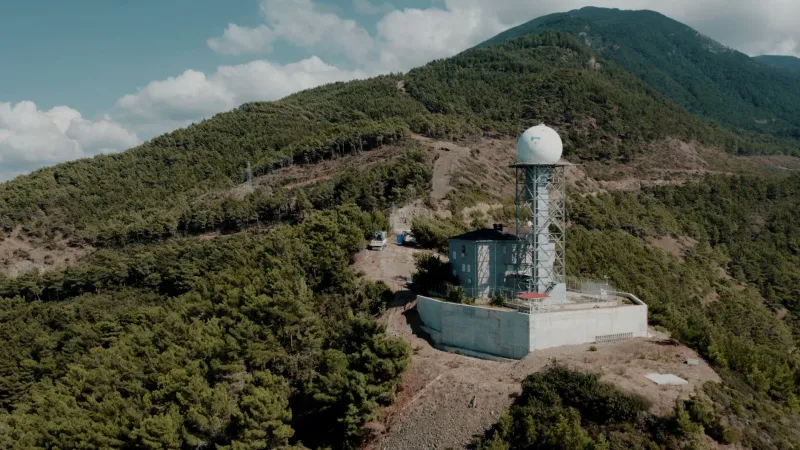
The UK's ground-based radar infrastructure does not rely upon a single, centralised installation. Instead, it is deliberately dispersed across the country, with stations positioned to exploit geography and maximise coverage. Elevated terrain in Scotland, the exposed headlands of Cornwall, the flat plains of eastern England — each location is chosen not for convenience but for line-of-sight advantage. Radar energy travels in straight lines, and the curvature of the Earth imposes hard limits on what any single station can detect at low altitudes. Positioning sensors on high ground extends that horizon considerably.
At the heart of the network sits the Air Surveillance and Control System, better known as ASACS. This framework integrates data feeds from multiple radar sources into a composite recognised air picture, or RAP, which is shared with NATO partners and feeds directly into the decision-making of Quick Reaction Alert controllers. When an unidentified contact appears on the RAP, the chain of response is rapid and well-rehearsed.
Primary radar installations, which detect objects by bouncing radio waves off their surfaces and measuring the return signal, are complemented by secondary surveillance radar systems that interrogate transponders aboard cooperative aircraft. The combination allows controllers to separate the thousands of routine civilian flights transiting UK airspace from any track that warrants closer scrutiny.
Key Installations Across the Estate
While operational security necessarily limits the detail available in open sources, several radar sites are publicly acknowledged as components of the UK's air defence architecture. RAF Buchan in Aberdeenshire, RAF Staxton Wold in North Yorkshire, and RAF Trimingham in Norfolk are among those that have formed part of the network's history, with some sites having been consolidated or upgraded as technology has evolved.
RAF Boulmer in Northumberland occupies a particularly significant position. As the home of Air Surveillance and Control System operations, Boulmer serves as the nerve centre through which much of the compiled air picture is managed. The station's controllers work in close coordination with the Combined Air Operations Centre at RAF High Wycombe, ensuring that tactical awareness translates seamlessly into command decisions.
In Scotland, the strategic importance of coverage over the North Atlantic and the approaches from the north has long justified investment in dedicated sensor capability. The proximity of Russian long-range aviation activity to UK airspace — a pattern that has intensified in recent years — makes northern radar coverage not merely useful but essential.
The Human Dimension
Technology, however sophisticated, does not interpret itself. Behind every radar return is a trained operator whose judgement determines whether a contact is routine or requires escalation. RAF Air Traffic Control and Aerospace Battle Management specialists undergo rigorous training before taking their place at an operational console. The ability to maintain concentration across extended watches, to apply procedural discipline under pressure, and to communicate with precision across multiple agencies simultaneously are skills developed over months of structured instruction.
The work is demanding in ways that are not always immediately apparent. Shifts run through the night, through weekends, through public holidays. The radar does not pause for Christmas, and neither do those tasked with reading it. Personnel stationed at remote sites across the country often operate in conditions far removed from the relative comfort of a main operating base, contending with harsh weather, limited local amenities, and the particular psychological weight of knowing that their attention is the difference between a timely response and a dangerous gap in national awareness.
Retention of experienced personnel within this specialisation remains an ongoing challenge for the RAF, as it does across much of the technical workforce. The expertise required to operate and maintain complex radar systems is not acquired quickly, and the competing attractions of the private sector — where similar skills command considerable salaries — create a persistent recruitment dynamic that defence planners must continually address.
Modernisation and the Emerging Threat Landscape
The radar estate that served Britain adequately through the Cold War and the decades that followed was designed around a specific threat model: large, fast-moving aircraft approaching at medium to high altitude. The contemporary threat environment is considerably more varied. Unmanned aerial systems, cruise missiles flying at very low altitudes to exploit terrain masking, and hypersonic glide vehicles present detection challenges that legacy sensors were never engineered to meet.
In response, the Ministry of Defence has been investing in upgraded sensor technologies capable of addressing these gaps. The Long Range Radar programme, intended to replace ageing primary radar installations with modern solid-state systems offering improved reliability and enhanced low-level detection performance, represents one strand of this effort. Solid-state transmitters eliminate many of the maintenance burdens associated with older tube-based technology, reducing the logistical overhead at remote sites where engineering support is not always readily available.
Passive radar — a technique that exploits existing commercial broadcast signals rather than emitting its own energy — is also attracting increasing interest as a complementary capability. Because passive systems do not transmit, they are inherently more difficult for an adversary to detect or suppress, offering a degree of survivability that active radar cannot match.
Integration with space-based assets and with the data streams generated by allied nations' sensor networks further enriches the air picture available to UK controllers. NATO's collective air surveillance architecture means that a contact tracked by Norwegian radar as it clears the Norwegian Sea may already be known to British controllers before it approaches UK airspace, providing valuable additional reaction time.
An Unseen but Indispensable Capability
In an era when defence procurement debates tend to focus on next-generation fighter aircraft and advanced missile systems, the radar network that underpins every aspect of UK air defence rarely receives the public attention it deserves. Yet without it, the most capable interceptor in the world cannot be directed to where it is needed, and the most sophisticated air defence missile battery cannot engage a target it cannot see.
The stations scattered across Britain's geography are not glamorous postings. They do not generate the headlines that fast jet operations attract. But they represent something arguably more fundamental: the persistent, patient, unrelenting act of watching. In a strategic environment that grows more complex with each passing year, that quiet vigilance may prove to be among the most valuable contributions the Royal Air Force makes to the defence of the United Kingdom.