On the Edge of the Envelope: Inside the Secretive World of RAF Experimental Test Pilots
There is a particular kind of courage that does not announce itself loudly. It does not wear a squadron patch or perform at airshows. It exists, largely unseen, in the restricted flight lines and classified briefing rooms of establishments such as the Empire Test Pilots' School (ETPS) at MoD Boscombe Down in Wiltshire — the cradle of British experimental flight testing and one of the most consequential institutions in the nation's defence architecture.
The men and women who graduate from ETPS and proceed into experimental test flying occupy a category apart from even the most experienced frontline aviators. They are, in the most literal sense, the first human beings to discover what a new aircraft or weapons system will do when pushed beyond the boundaries of its design specification — and, critically, what it will do when something goes wrong.
What Experimental Test Flying Actually Means
The term "test pilot" is frequently misunderstood by the general public, often conjuring images of daredevil stunts or record-breaking speed runs. The reality is considerably more disciplined, and in many respects more demanding. Experimental test flying is fundamentally an engineering discipline conducted in the most unforgiving laboratory imaginable: the sky.
When a new aircraft platform — or a significantly modified variant of an existing one — reaches the flight test phase, it carries with it a catalogue of theoretical predictions generated by aerodynamicists, structural engineers, avionics specialists, and propulsion experts. The test pilot's role is to systematically validate or challenge those predictions across the full breadth of the aircraft's intended operational envelope. This means deliberately inducing conditions that operational pilots are trained to avoid: departure from controlled flight, compressor stalls, asymmetric thrust scenarios, and structural loading at the outer margins of what the airframe is certified to tolerate.
Every such sortie is meticulously planned. Abort criteria are established in advance. Chase aircraft are positioned. Telemetry streams live data to engineers on the ground who monitor parameters in real time. And yet, by the very nature of the exercise, the unexpected remains an ever-present companion.
The Psychological Architecture of a Test Pilot
Selection for experimental test flying demands not merely exceptional airmanship but a specific cognitive profile. Candidates must demonstrate the capacity to remain analytically composed under conditions that would provoke acute stress responses in most individuals. When an aircraft behaves unexpectedly at high altitude and high speed, the test pilot must simultaneously manage the aircraft, assess the situation, record observations, and communicate clearly with the ground — all whilst suppressing the instinctive reactions that self-preservation demands.
Psychological preparation at ETPS is therefore as rigorous as the technical curriculum. Pilots are trained in structured decision-making frameworks that function even when cognitive load is at its peak. They study accident reports with forensic attention, not merely to understand what went wrong in historical incidents, but to internalise the cognitive traps — confirmation bias, plan continuation, task saturation — that have contributed to test flight fatalities throughout aviation history.
Former graduates frequently describe the experience as a fundamental restructuring of how they process uncertainty. Where an operational pilot is trained to respond to known threats with rehearsed procedures, a test pilot must be comfortable operating in a space where the procedures themselves are what is being written.
Safety Protocols and the Architecture of Managed Risk
British experimental flight testing operates under a framework of managed risk rather than eliminated risk — a distinction that matters enormously. The Defence and Security Accelerator and the MoD's test and evaluation community have developed layered safety architectures designed to reduce the probability of catastrophic outcomes whilst preserving the capacity to gather meaningful data at the edges of the performance envelope.
Flight test cards — the detailed, sequenced plans governing each sortie — are reviewed by multi-disciplinary safety review boards before a single engine is started. Risk is quantified wherever possible, and mitigation measures are documented. Ejection seat parameters, emergency recovery altitudes, and communication protocols are all pre-briefed with the precision of a surgical procedure.
Nevertheless, the community is candid about what cannot be engineered away. The history of British experimental aviation contains sobering chapters. Aircraft have been lost. Pilots have not returned. The names on the memorial at Boscombe Down serve as a permanent reminder that the work carries genuine mortal weight, and that the safety frameworks exist not to create a fiction of invulnerability but to honour the seriousness of what is being asked of these aviators.
The Unique Pressures of Classified Development Programmes
A dimension of experimental test flying that receives comparatively little public attention is the burden of operating within classified development programmes. Test pilots working on next-generation platforms — including elements of the wider Global Combat Air Programme ecosystem and sensitive modifications to current fast jet and surveillance fleets — do so under strict information security constraints that extend beyond the professional into the personal.
They cannot discuss the specifics of their work with family members. They cannot share concerns with colleagues outside the programme. In some cases, the very existence of a particular test phase is itself a classified matter. This enforced compartmentalisation adds a layer of psychological isolation to an already demanding professional environment, and the pastoral support structures within the test flying community have evolved to account for it.
The culture at establishments like Boscombe Down places considerable emphasis on peer support and internal communication. The test flying community is small — globally as well as domestically — and its members tend to understand, without needing explicit explanation, the particular pressures their colleagues are navigating.
What They Deliver and Why It Matters
The outputs of experimental test flying are not abstract. Every clearance that allows an operational RAF pilot to employ a new weapon, fly at a previously restricted altitude, or manoeuvre within an expanded g-envelope traces its authority back to a test flight — and to the pilot who flew it first.
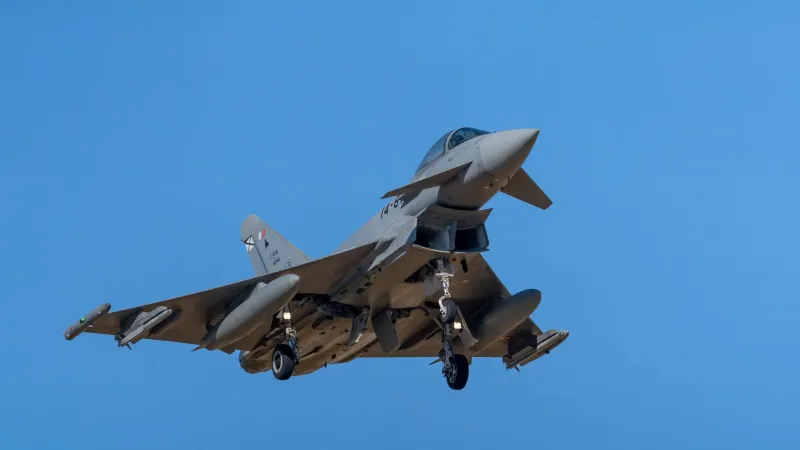
When Typhoon pilots operated with expanded stores configurations over operational theatres, those clearances existed because test pilots had systematically explored the aerodynamic and structural implications beforehand. When F-35B Lightning aircraft operating from HMS Queen Elizabeth pushed the boundaries of shipborne fast jet operations, the foundation of that confidence was laid in test programmes that demanded enormous professional courage from a very small number of people.
As Britain moves towards the development and eventual introduction of sixth-generation combat capability, the role of the experimental test pilot will only grow in significance. The complexity of integrated sensor systems, directed energy weapons, autonomous collaborative platforms, and advanced propulsion technologies will generate test programmes of unprecedented technical depth — and unprecedented demand on the aviators asked to validate them.
The Quiet Guardians of British Air Power
There is a particular irony in the fact that the individuals arguably most responsible for the operational effectiveness of the RAF's future fleet are among its least publicly recognised. Experimental test pilots do not feature prominently in recruitment campaigns or parliamentary statements on defence capability. Their achievements are often classified, their risks largely invisible.
And yet it is precisely this invisibility that defines their contribution. Every aircraft that flies with confidence, every system that performs as intended, every operational pilot who returns safely from a mission — each of these outcomes rests, in part, on the foundation laid by those who flew the aircraft first, into the unknown, so that others would not have to.
In that sense, the experimental test pilot embodies something essential about Britain's approach to air power: a commitment to rigour, to intellectual discipline, and to accepting personal risk in service of collective security. It is unglamorous work, frequently thankless, and entirely indispensable.