Fortress at the Edge of the World: The RAF Pilots Holding Britain's Most Isolated Front Line
The Posting Nobody Talks About
In the hierarchy of RAF assignments, a tour at RAF Mount Pleasant rarely features in the glamorous narratives that populate recruitment brochures or air show commentary. There are no urban amenities within reasonable reach, no allied air forces conducting daily joint exercises on the adjacent pan, and precious little acknowledgement from the broader British public that the posting even exists. Yet for the small cadre of Typhoon pilots and supporting personnel who rotate through the Falkland Islands Air Defence (FIAD) commitment, Mount Pleasant represents one of the most operationally consequential — and psychologically demanding — assignments the service offers.
Situated on East Falkland, roughly 30 miles west of Stanley, RAF Mount Pleasant has served as Britain's principal military installation in the South Atlantic since its construction in the mid-1980s, built in direct response to the lessons of the 1982 conflict. Today it houses a standing Quick Reaction Alert capability, maintained continuously regardless of season, weather, or the relative quiet of the geopolitical environment. That quiet, it should be noted, is relative rather than absolute.
Strategic Context: Why the Falklands Still Matter
To understand the weight of the Mount Pleasant posting, one must first appreciate why Britain continues to invest in a defended garrison on islands with a civilian population of fewer than four thousand people. The answer lies less in demography than in geography and sovereign principle.
The Falkland Islands sit astride critical South Atlantic shipping lanes and are positioned within proximity of resource-rich maritime zones. Britain's Exclusive Economic Zone around the islands encompasses waters of considerable commercial and scientific significance. More fundamentally, the defence of the Falklands represents an explicit commitment to the principle that British Overseas Territories and their populations will not be abandoned to external pressure — a principle whose credibility depends entirely on the visible maintenance of credible force.
Argentina has never formally renounced its territorial claim over the islands, which it refers to as the Malvinas. Whilst diplomatic relations between London and Buenos Aires have ebbed and flowed over the decades, the underlying dispute has not been resolved. Any diminution of the RAF's presence at Mount Pleasant would be interpreted — both in Buenos Aires and in Stanley — as a signal of weakening resolve. The pilots stationed there are, in the most literal sense, the embodiment of a political guarantee.
Operating at the Edge of Endurance
The operational environment at Mount Pleasant is unforgiving in ways that differ markedly from the challenges faced by pilots at Lossiemouth or Coningsby. The South Atlantic weather system is notorious for its volatility. Winds that would close a continental European airfield are, at Mount Pleasant, simply Tuesday. Pilots must develop an acute familiarity with rapidly changing conditions, conducting approaches and recoveries in circumstances that demand both technical precision and considerable composure.
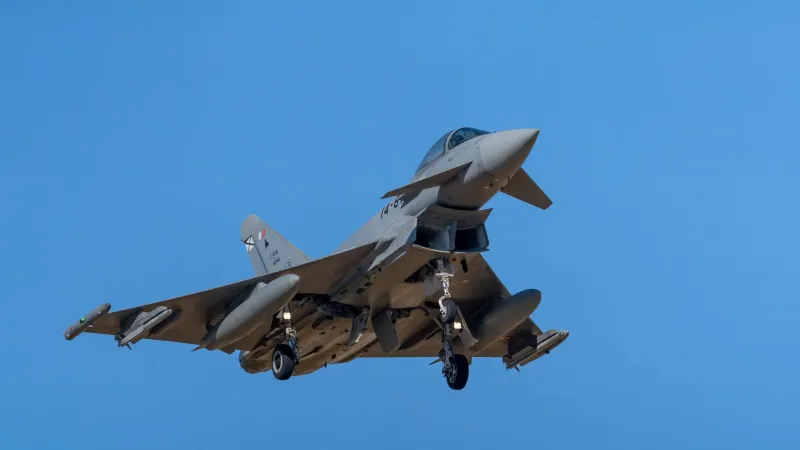
The Typhoons assigned to FIAD are maintained to full combat readiness, capable of launching on QRA within minutes. However, the tyranny of distance introduces a logistical dimension that home-based squadrons seldom encounter at the same intensity. Spare parts, specialist equipment, and engineering expertise must travel eight thousand miles to reach the island. The supply chain is long, the margin for error is narrow, and the engineering teams who support the aircraft perform extraordinary work to sustain serviceability rates that would be considered commendable anywhere in the world.
Pilots rotating through Mount Pleasant typically serve on tours of several months, sufficient time to develop genuine familiarity with the local airspace and threat environment, but also long enough for the psychological weight of isolation to become a real management challenge. The Falklands offer limited recreational infrastructure, limited connectivity with family and friends at home, and an environment in which the social texture of a large RAF station — the Officers' Mess banter, the proximity of civilian life, the easy accessibility of leave — is simply absent. Those who thrive tend to be individuals who find genuine professional satisfaction in the rigour of the task itself.
The Threat Picture
Discussing the precise nature of the air threat that FIAD is designed to counter requires appropriate circumspection, but certain broad observations are a matter of public record. Argentina operates a modest but modernising air force, and the broader South American region contains several nations with credible fast jet fleets. The RAF's presence at Mount Pleasant is calibrated to provide a deterrent capability rather than to suggest that conflict is imminent — but deterrence only functions when the capability behind it is genuine and demonstrably maintained.
Beyond conventional air threats, the evolving landscape of unmanned aerial systems and the potential for grey-zone provocations add layers of complexity to the threat assessment that pilots and intelligence staff at Mount Pleasant must continuously incorporate into their operational planning. The days when QRA in the South Atlantic was a straightforward matter of intercepting a single unidentified contact have given way to a more nuanced and demanding analytical environment.
Isolation as a Crucible
Speak to any pilot who has completed a Falklands tour and a consistent theme emerges: the posting strips away distraction and forces a clarity of professional focus that is difficult to replicate elsewhere. Without the social noise of a large garrison town, without the easy escape of a weekend in a nearby city, the work itself becomes the primary organising principle of daily life. Pilots fly more, think more deeply about what they fly, and develop an intimacy with their aircraft and their procedures that serves them well throughout the remainder of their careers.
There is also an esprit de corps particular to small, isolated detachments. The community at Mount Pleasant is tight-knit by necessity, and the bonds formed during a South Atlantic tour are frequently described by veterans as among the most durable of their service careers. The shared experience of operating at the edge of Britain's reach, in conditions that demand genuine mutual reliance, produces a cohesion that more comfortable postings rarely generate.
An Unglamorous Necessity
The RAF's commitment to the Falkland Islands will not generate the column inches devoted to the Typhoon's performance over contested European airspace, nor the strategic commentary that accompanies announcements about sixth-generation programmes or NATO exercises. It is, by almost any measure, an unglamorous posting — and yet it represents something fundamental about what the Royal Air Force is and what it is called upon to do.
Britain's ability to project sovereign credibility across vast distances, to maintain a credible defence posture in a remote and demanding environment, and to sustain the morale and professionalism of a small detachment far from home — these are not peripheral capabilities. They are, in many respects, the most honest expression of what an expeditionary air force actually means in practice.
The pilots of FIAD do not seek recognition. They seek, as all RAF aviators do, the satisfaction of a task executed to the highest standard. In that, at least, Mount Pleasant offers something in uncommon abundance.