Concrete and Memory: The Slow Erasure of Britain's RAF Heritage Landscape
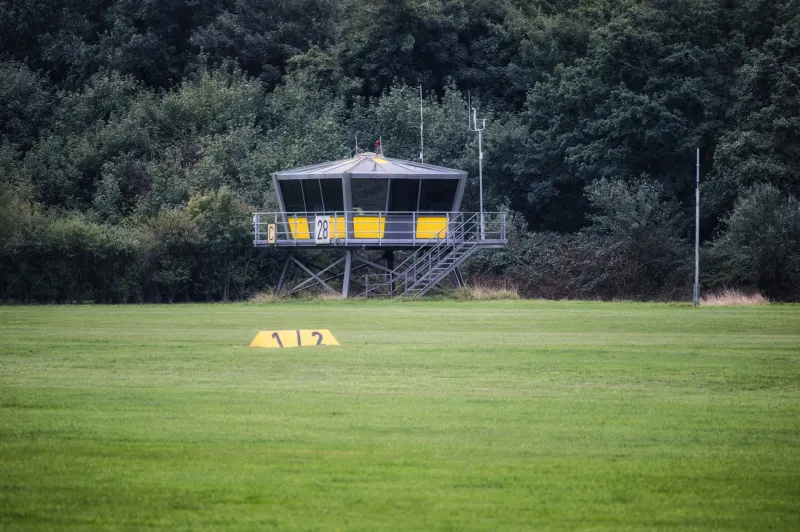
Stand at the edge of what was once RAF Hemswell in Lincolnshire on a still morning, and the geometry of the past remains faintly legible in the landscape. The sweep of a former perimeter track, the outline of a dispersal pan, the hulking silhouette of a Type J hangar — all speak, however faintly, of a time when this place was alive with the noise and purpose of operational flying. Much of what surrounds these remnants, however, has been consumed by housing, industrial units, and the quiet indifference of development.
Hemswell is not an isolated case. Across the United Kingdom, from the Lincolnshire wolds to the Kentish weald, from the Scottish Highlands to the flatlands of East Anglia, the physical fabric of Britain's RAF heritage is being dismantled with a speed and thoroughness that alarms those who understand what is being lost.
The Scale of Disappearance
The RAF operated over 700 airfields in Britain during the Second World War alone. Many were temporary grass strips, their traces long since ploughed back into farmland. But a substantial number were permanent stations — equipped with concrete runways, hardened dispersals, technical buildings, and accommodation blocks — whose infrastructure was designed to endure decades of operational use.
The postwar contraction of the RAF, accelerated by successive defence reviews from the 1950s onwards, rendered the majority of these stations redundant. The 1957 Defence White Paper, the Options for Change review of 1990, and the Strategic Defence and Security Reviews of 2010 and 2015 each contributed successive waves of closure, releasing land back to local authorities and private developers.
What followed, in many cases, was rapid and largely unregulated redevelopment. Planning authorities, under pressure to deliver housing targets, frequently granted permission for schemes that obliterated the historic character of former stations without adequate archaeological recording or heritage assessment.
"We are losing these sites faster than we can document them," says Dr Eleanor Marsh, an aviation archaeologist at the University of Lincoln who has spent fifteen years surveying former RAF installations across the East Midlands. "Once a control tower is demolished or a blast pen is buried under a road, that physical evidence is gone permanently. The archival record is no substitute for the material reality."
More Than Bricks and Mortar
The case for preserving former RAF stations is sometimes dismissed as mere nostalgia — a sentimental attachment to crumbling concrete that impedes necessary development. This characterisation fundamentally misunderstands what these sites represent.
Britain's wartime and Cold War airfields are, in the most direct sense, monuments to national sacrifice. The operations mounted from stations such as RAF Scampton, RAF Binbrook, and RAF Coningsby shaped the course of twentieth-century history. The men and women who served at these locations — many of whom did not survive — left behind a physical environment that connects the present to that experience in ways that no museum exhibit or digital archive can fully replicate.
Former RAF navigator Group Captain (Retired) Philip Denton, who flew Vulcan bombers from several Lincolnshire stations during the Cold War, describes his reaction to the redevelopment of a former posting.
"I drove past what used to be the crew room last year," he says. "It's a storage facility for a logistics company now. The dispersal where we used to sit in the aircraft on Quick Reaction Alert — tarmacked over for lorries. I'm not a sentimental man, but that felt like a desecration. Those were significant places, and they've been treated as if they had no meaning at all."
The Preservation Landscape
The effort to conserve what remains is fragmented and under-resourced. A network of dedicated volunteer organisations — including the Airfield Research Group, the Defence of Britain Project, and numerous station-specific heritage associations — works to record, interpret, and where possible protect surviving structures. Their commitment is formidable; their resources are not.
Historic England, the statutory body responsible for the protection of the built heritage, does designate some former military structures. Scheduled monument status has been awarded to a number of RAF-associated sites, including sections of the Chain Home radar network and certain Cold War bunkers. But the listing process is slow, the criteria demanding, and the proportion of surviving RAF infrastructure that enjoys any formal protection remains small.
The situation is further complicated by the fact that many former station buildings, whilst historically significant in aggregate, are individually unremarkable. A standard-pattern RAF watch office or airmen's barrack block derives its significance not from architectural distinction but from historical association — a quality that the statutory heritage framework struggles to accommodate.
What Is Being Lost
Beyond the physical structures, the closure and redevelopment of former stations extinguishes something harder to quantify: the sense of place that connects communities to their aviation past.
Many former RAF stations were embedded in the social fabric of their surrounding towns and villages for generations. The relationship between a station and its local community — the shared history of wartime sacrifice, the economic dependence, the cultural memory — is severed when the site is redeveloped without acknowledgement of what it once was.
Local historian Margaret Sowerby, who has spent a decade compiling oral histories from former residents of communities adjacent to closed Lincolnshire stations, describes the human dimension of this loss.
"The people who remember these places as living, working stations are dying," she says plainly. "When the last person who remembers the sound of Lancasters taking off from a particular airfield is gone, and the airfield itself has been built over, what remains? A street name, perhaps. Maybe a small plaque if someone thought to put one up. That is not an adequate memorial to what happened there."
Towards a Better Framework
The solution does not require the wholesale preservation of every surviving RAF structure — a position that would be neither practical nor, in many cases, desirable. What is required is a more systematic and adequately funded approach to identifying, recording, and selectively protecting the most significant surviving elements of Britain's RAF heritage landscape before they are lost.
This means mandatory heritage impact assessments for development proposals on former station sites, greater use of planning conditions to require archaeological recording, and increased investment in the voluntary sector organisations that currently carry a disproportionate share of the conservation burden.
It also means a cultural shift — in planning authorities, in central government, and in the public understanding of what military heritage represents. The airfields of Britain are not relics of a distant and irrelevant past. They are the physical expression of a national effort that defined the twentieth century, and their loss diminishes the country's capacity to understand and communicate that experience to future generations.
The concrete is crumbling. The clock, for many of these sites, is already very nearly at midnight.