Vertical Ambitions: The Transformation of RAF STOVL Pilot Training from Jump Jet to Lightning
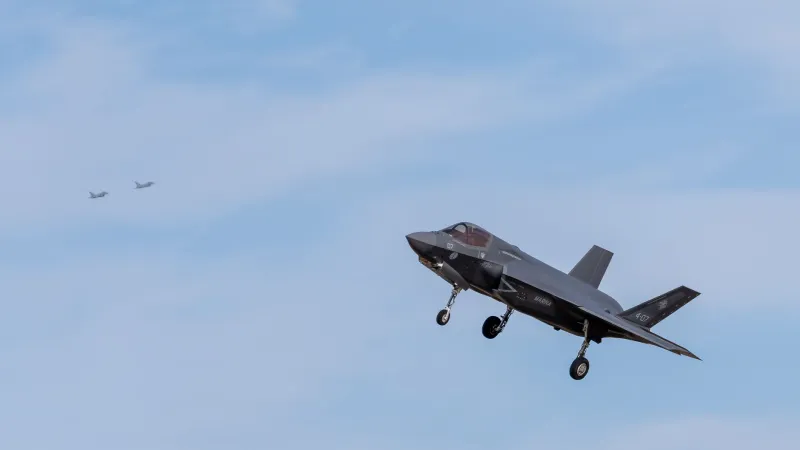
Few capabilities in military aviation demand as much from a pilot as vertical and short takeoff and landing operations. The physics alone are unforgiving: thrust vectoring, hover management, and the constant interplay between forward speed and jet-borne flight create a cockpit environment that separates the merely competent from the genuinely exceptional. For the Royal Air Force, the journey from the legendary Harrier GR series to the Lockheed Martin F-35B Lightning II has required nothing short of a wholesale reinvention of how STOVL pilots are selected, trained, and sustained in their skills.
Understanding that transformation requires looking back at what the Harrier era demanded — and forward at what the F-35B era now expects.
The Harrier School: Learning to Fly on a Column of Air
The Harrier's introduction into RAF service in the late 1960s presented training establishments with a problem unlike anything previously encountered in British military aviation. Here was an aircraft that could hover, transition through flight regimes at will, and operate from forest clearings and ship decks alike. Teaching pilots to handle it safely — let alone tactically — required building an entirely new body of institutional knowledge from scratch.
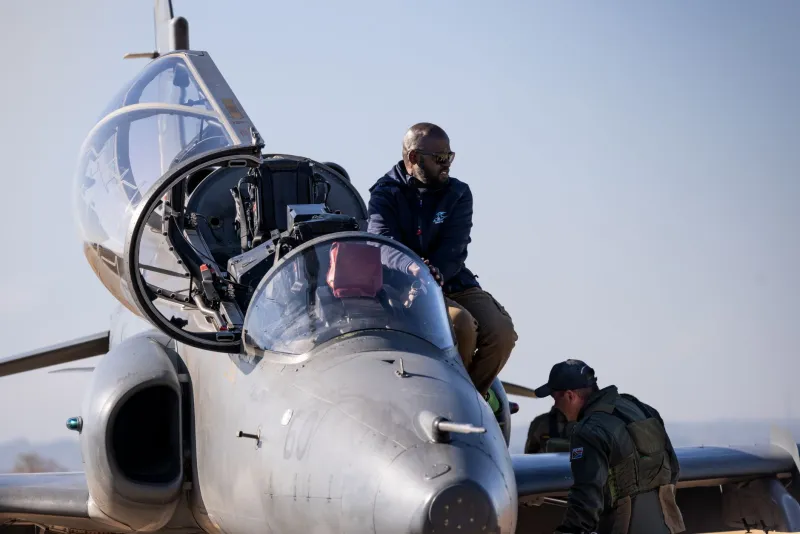
At RAF Wittering, which served as the spiritual home of Harrier operations for decades, instructors developed a training philosophy centred on graduated exposure to the nozzle. Student pilots would first master conventional flight in the two-seat T.4 variant before being introduced to short takeoffs and, eventually, the hover itself. The hover was — and remains — the most psychologically demanding phase. Unlike helicopter operations, where the rotor system provides inherent stability cues, the Harrier's hover demanded that pilots synthesise visual references, engine noise, and seat-of-the-pants feel into a coherent picture of aircraft position. There were no automated systems to catch a mistake; the pilot was, in every meaningful sense, the stability augmentation system.
Instructors from that era frequently describe the hover check as a moment of revelation. Pilots either possessed the spatial awareness and fine motor control to manage it, or they did not. Washout rates during the hover phase were significant, and the RAF accepted this as the necessary cost of maintaining a genuinely capable STOVL force.
The Interregnum: What the Gap in Capability Cost
When the Harrier force was controversially retired in 2010 as part of the Strategic Defence and Security Review, the RAF lost more than aircraft — it lost an institutional memory that had taken four decades to build. Experienced STOVL instructors left the service. The unique mental models required for nozzle management and transition flying began to fade from the active knowledge base. Officers who had grown up with the Harrier moved on, and a generation of fast jet pilots entered service having never touched a STOVL aircraft.
This was not a trivial matter. When the F-35B programme began to mature and the decision to operate the short takeoff and vertical landing variant was confirmed for both the RAF and the Royal Navy, planners confronted an uncomfortable reality: Britain would need to rebuild STOVL expertise largely from first principles, albeit with far more sophisticated tools at its disposal.
Rebuilding the Pipeline: How F-35B Training Was Constructed
The reconstitution of British STOVL training capability was a deliberate and carefully sequenced process. RAF and Royal Navy personnel destined for the F-35B were initially sent to the United States, training alongside American Marine Corps pilots at MCAS Beaufort in South Carolina and, later, at Luke Air Force Base in Arizona. This arrangement provided access to the aircraft, the instructors, and — critically — the accumulated American experience with the F-35B that Britain could not yet generate domestically.
Upon the establishment of 617 Squadron's operational capability at RAF Marham in Norfolk, the focus shifted to developing a distinctly British training architecture. The F-35B's advanced mission systems meant that the training pipeline had to address not just the physical demands of STOVL flight, but the cognitive demands of operating one of the most sensor-rich cockpits in the world.
Here, simulator technology proved transformative. Unlike the Harrier era, when synthetic training was of limited fidelity and pilots largely had to learn STOVL handling in the actual aircraft, the F-35B programme benefits from full-mission simulators capable of replicating carrier deck operations, hover approaches, and short rolling vertical landings with a degree of accuracy that would have been unimaginable to Wittering instructors in the 1970s. Pilots can now rehearse a vertical landing on the deck of HMS Queen Elizabeth in a simulator at Marham before ever setting foot on the carrier itself — a capability that has materially reduced risk during the early stages of carrier qualification.
The Mindset Shift: From Instinct to System Management
Perhaps the most profound difference between Harrier training and F-35B training lies in the relationship between pilot and aircraft systems. The Harrier demanded raw instinct and physical sensitivity; the F-35B demands that pilots trust — and intelligently manage — a suite of automated systems that handle much of the stabilisation work that Harrier pilots performed manually.
This represents a genuine cultural adjustment. RAF fast jet culture has historically prized raw handling skill and manual precision. The F-35B asks pilots to redirect that energy towards mission management, sensor fusion, and tactical decision-making, confident that the aircraft's control laws will manage the hover dynamics that once consumed a Harrier pilot's full attention.
Instructors at Marham are careful to note that this does not mean the F-35B is easy to operate. The aircraft's complexity introduces its own demanding learning curve, and the consequences of mismanaging a vertical landing aboard a carrier remain severe regardless of automation. What has changed is the nature of the skill set required, not the absolute standard of excellence expected.
Carrier Integration: The New Frontier of STOVL Training
The reintroduction of carrier aviation to the Royal Navy — and by extension to the RAF personnel who fly from HMS Queen Elizabeth and HMS Prince of Wales — has added a dimension to STOVL training that the Harrier era only partially addressed. While Harriers did operate from Invincible-class carriers during the Falklands conflict and beyond, the scale and tempo of operations envisaged for the Queen Elizabeth class demands a far more structured approach to carrier qualification.
Pilots must now navigate not only the technical demands of short rolling takeoffs from the ski-jump and vertical landings on a moving deck, but also the procedural complexity of operating within a carrier strike group environment. Communication protocols, deck choreography, and the management of fuel states during extended maritime operations all form part of the modern STOVL training syllabus in ways that were less formalised during the Harrier years.
An Evolving Legacy
The RAF's journey from Harrier to F-35B is, at its core, a story about institutional resilience and the willingness to rebuild hard-won expertise when circumstances demand it. The vertical flight community within British military aviation has always occupied a special place — demanding, technically unforgiving, and operationally irreplaceable. That community is once again growing, shaped by modern tools but animated by the same fundamental challenge that faced the first Harrier pilots at Wittering more than half a century ago: learning to fly on a column of air, and making it look effortless.